The short version: HSC Practice helps teachers turn a chosen syllabus focus into an original Chemistry practice-question draft — with the checks, context and review trail needed to decide whether it belongs in front of a class.
The problem I wanted to solve#
Writing a good HSC Chemistry question is much more than changing a few numbers in an old worksheet. A useful question needs a clear learning focus, an appropriate directive verb, a fair mark allocation, scientifically sound working, and a marking approach that rewards the intended reasoning.
That makes the usual shortcut — find an old question and lightly remix it — feel unsatisfying. It can narrow practice to familiar shapes and offers little visibility into why a question is suitable.
I built HSC Practice around a different premise: start with the syllabus intent, describe the assessment task deliberately, produce an original draft, and make its path to review visible. The system is designed to support a teacher’s judgement, not replace it.
The core idea: a contract before a question#
Before HSC Practice drafts anything, it builds an assessment contract. This is the small but important bridge between “I want practice on this concept” and a question that is actually fit for purpose.
| Design choice | What it controls | Why it matters |
|---|---|---|
| Syllabus selection | The concepts and boundaries in scope | Keeps practice anchored to a deliberate learning target |
| Directive term | The kind of response expected | Makes “explain”, “calculate”, and “assess” meaningfully different |
| Mark value | The scale of the response | Prevents a one-idea question carrying too many marks |
| Difficulty profile | Conceptual, procedural, mathematical, and literacy demand | Lets a task be challenging in a purposeful way |
| Evidence and stimulus preferences | What students should work with | Encourages questions that ask for reasoning, not recall alone |
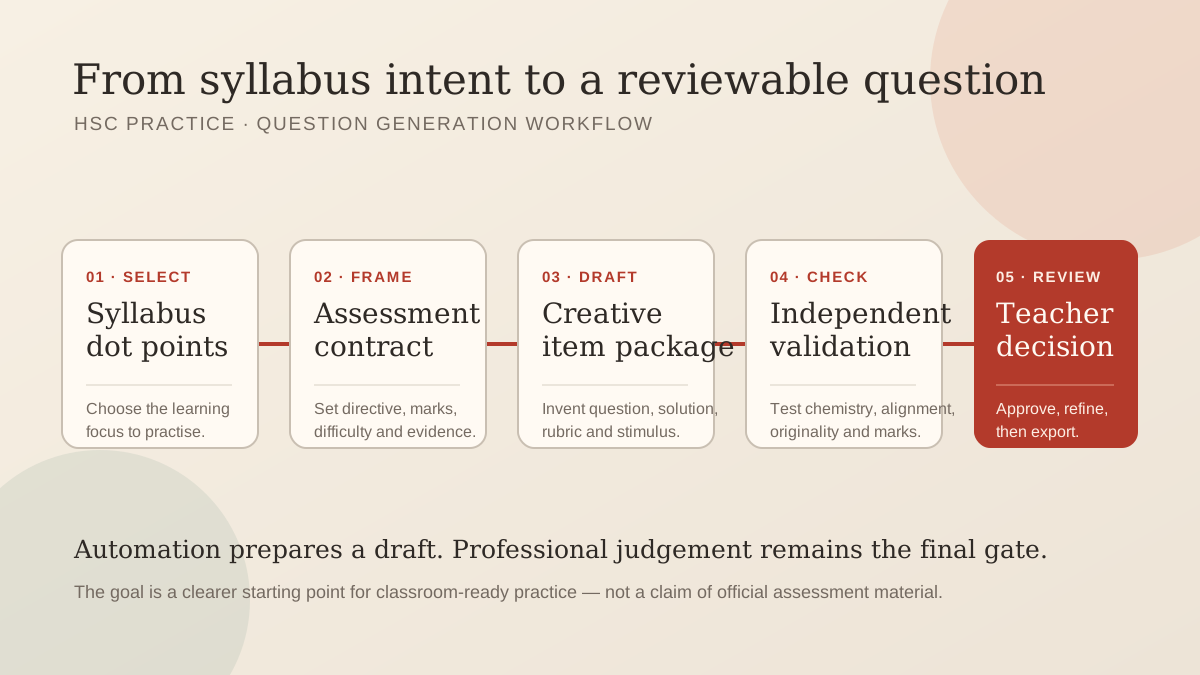
In compact form, the product story looks like this:
syllabus focus
    → assessment contract
    → original item package
    → independent checks
    → teacher review
    → classroom export
The contract is not a template for the final question. It is a set of guardrails that gives the drafting step a clear destination while leaving room for a genuinely new assessment relationship.
A workflow with visible gates#
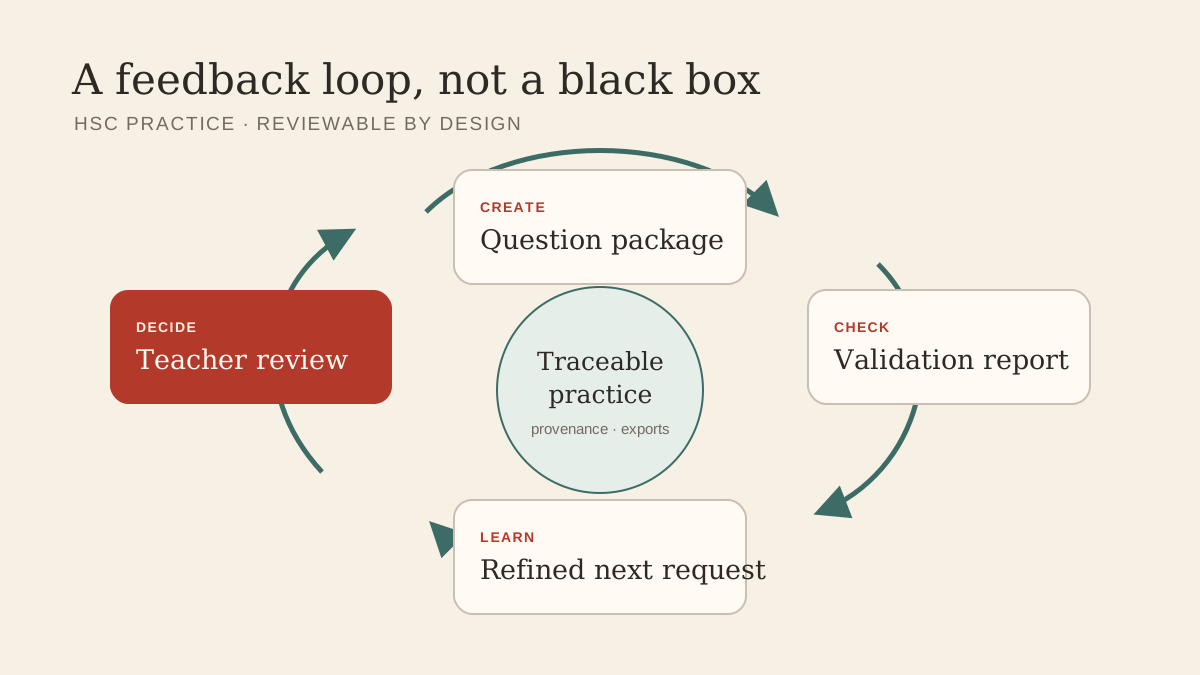
The workflow deliberately separates creation from acceptance:
- A teacher selects the relevant syllabus dot points and the intended assessment shape.
- HSC Practice creates a question package: the question, worked solution, marking guidance and, where helpful, a stimulus.
- Independent checks assess areas such as chemistry claims, syllabus alignment, mark load, provenance and originality signals.
- If a draft needs attention, the system can attempt a bounded repair or retain the reasons it was blocked.
- A teacher reviews the result, records a decision, and exports the approved resource in Markdown or LaTeX.
That separation matters. An automated check can identify a mismatch or validate a supported calculation; it cannot decide what a particular class needs next Tuesday. HSC Practice makes that boundary explicit.
What “original” means here#
Originality is easy to overstate, so I try to be precise about it. HSC Practice uses historical assessment material as evidence about style and coverage, not as a set of copy-and-paste templates. It checks local source material for concerning overlap and preserves provenance alongside the generated draft.
What HSC Practice does not claim
It does not present generated questions as official NESA material, promise that automated checks are proof of every scientific claim, or publish a draft without a teacher decision.
The practical goal is more modest — and more useful: give a teacher an interesting, inspectable starting point that is less likely to be a thin variation on something students have already seen.
Chemistry is a domain problem, not just a writing problem#
The first production focus is HSC Chemistry, where small errors can change the entire question. A plausible-looking equilibrium prompt may use the wrong condition; a numerical pathway might reward the wrong units; a reaction representation can be technically valid but pedagogically misleading.
HSC Practice therefore keeps chemistry-aware validation separate from the drafting model. It has structured catalogue data, module-specific constraints and targeted checks for areas such as equilibrium, quantitative chemistry, acids and bases, energetics, organic chemistry, and analytical techniques.
For example, a response package can be judged against a relationship such as:
The equation itself is not the teaching. The important part is whether the question’s conditions, solution and marking guidance all agree about how to reason with it.
A small example of the design brief#
focus: equilibrium response to a changed condition
directive: justify
marks: 4
difficulty:
  conceptual: high
  procedural: medium
  mathematical: low
  literacy: medium
stimulus: graph-or-diagram
This kind of brief gives a question enough shape to be assessable without forcing it into a recycled scenario. It also makes the eventual resource easier to interrogate: Was the difficulty intentional? Did the stimulus serve the reasoning? Does the rubric match four marks?
Richer practice materials, not just a text box#
Chemistry questions often depend on a well-made visual. HSC Practice includes a diagram-making path for graphs, process diagrams, particle models, tables, spectra and other assessment stimuli. The goal is to treat the visual as part of the question’s meaning, rather than as decoration added at the end.
Here is the working checklist I use when thinking about a generated item:
- The syllabus focus is explicit.
- The question asks students to demonstrate the intended evidence.
- The solution and marking guidance account for the available marks.
- Automated checks and provenance are visible to the reviewer.
- A teacher has approved the item for a specific classroom context.
The final item stays intentionally unchecked until a teacher makes that decision. That is a product constraint, not a missing feature.
Building it as a full-stack system#
Under the surface, HSC Practice is a modular monolith: a Next.js application and PostgreSQL-backed teacher workflow, paired with a Python generation and chemistry engine behind an internal API. The architecture is intentionally boring in the best sense — one product surface, one managed deployment path, and a clean boundary around the domain-heavy work.
| Layer | Responsibility |
|---|---|
| Teacher workspace | Select content, design an item, inspect results and record review decisions |
| Generation engine | Assemble the contract, draft the item package and create exports |
| Chemistry and validation layer | Apply structured checks, report findings and support bounded repairs |
| Catalogue and source layer | Hold syllabus atoms, assessment observations, constraints and provenance |
| Audit trail | Preserve the package, validation report, review events and version context |
- Item package
- The question, worked solution, marking guidance, source context and generation metadata kept together.
- Bounded repair
- A limited attempt to address a repairable finding, followed by the same checks again — never an endless loop of silent rewriting.
- Provenance
- The traceable context that helps a reviewer understand where a draft came from and what checks it has passed.
What I learned building HSC Practice#
The biggest lesson has been that the useful part of an educational generation tool is not the moment it produces text. It is the structure around that moment: clear inputs, domain-aware checks, readable evidence, and a review flow that respects the person accountable for using the result.
HSC Practice is still a project in motion, but its direction is clear:
Create more room for thoughtful practice design — while keeping teachers in control of the final call.